
Why Retro Gaming is a Quality-of-Life Hack for Gaming Parents
Let’s be completely honest: modern AAA gaming has started to feel like a second job. You finally put the kids to bed, secure a precious 45-minute window of free time, fire up your console, and... boom. A mandatory 50GB day-one patch download blocks your screen, entirely devouring your night. Combine that with $80 price tags, aggressive microtransactions, and the fact that you don't even truly "own" your digital games anymore (you are just paying for a temporary license that publishers can revoke whenever they feel like shutting down a server), and it’s easy to see why gaming as a parent has become a high-friction hobby.
This is exactly why retro gaming is making a massive, culturally significant comeback. It is not just a wave of millennial nostalgia; it is a smart, intentional lifestyle choice. Tired parents are looking for ways to maximize their limited free time, protect their mental energy, and get back to the pure, uncomplicated joy of gaming.
Fascinatingly, this desire to disconnect from the modern digital grind is even bleeding into younger generations. Gen Z and Alpha are increasingly ditching their smartphones for older devices like the Nintendo DS. They love them because they are hip, compact, completely offline, and allow them to take low-fi photos without being bombarded by social media notifications. For both exhausted parents and screen-weary kids, retro tech represents a much-needed return to intentional, peaceful entertainment.
1. Entire Childhoods in Your Pocket
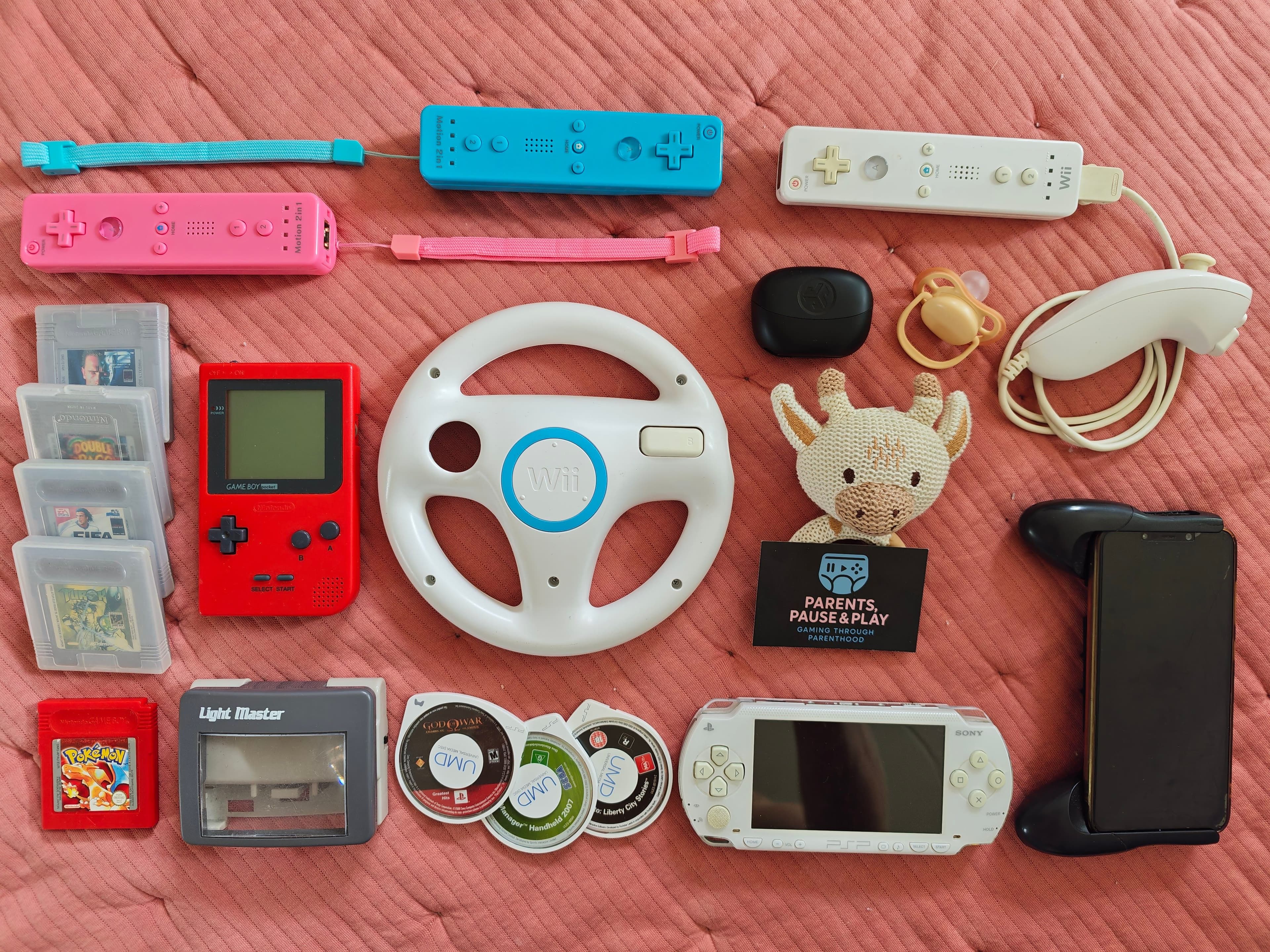
One of the best things about the retro resurgence is how beautifully the hardware adapts to parent life. Back in the day, playing classic games meant dominating the living room TV, wrestling with a tangle of wires, and blowing into dusty cartridges. Today, modern microchips allow us to pack entire console generations, from the 8-bit NES all the way up to the PlayStation 2 and GameCube eras, into a single, pocket-sized device.
For a parent who needs to stay mobile, this absolute portability is a game-changer. The current retro ecosystem offers a few brilliant ways to play, depending on how much friction you want to deal with:
- Dedicated Retro Handhelds
Pocket-sized devices from brands like Anbernic or the Miyoo Mini have exploded in popularity. They are highly affordable, feature gorgeous screens, and are built specifically to launch thousands of classic games instantly via simple custom software. - The Smartphone Powerhouse
You already carry an absolute retro beast in your pocket. If you have a smartphone with a reasonably powerful chip (like my POCO F8 Ultra), it can effortlessly emulate advanced classic consoles. Snapping on a high-quality mobile controller clip instantly transforms your phone into a premium handheld. (Quick disclaimer: To keep things ethically and legally clean, only emulate digital copies or ROMs of games you actually own). - Legacy Hardware and Secondhand Culture
For purists who want the exact tactile feel of their youth, dusting off an original Game Boy Pocket, a Nintendo DS, or a PlayStation Portable (PSP) is experiencing a massive revival. While hunting for physical games at flea markets and secondhand online shops is becoming a highly hyped (and increasingly expensive) hobby, nothing beats the feeling of the original plastic in your hands.

The Streaming Alternative
If you prefer a completely zero-effort, plug-and-play setup without dealing with files or emulation settings, modern consoles have you covered. Services like Nintendo Switch Online, PlayStation Plus tiers, and Xbox Game Pass allow you to stream or download curated lists of classic retro titles directly on your couch.
Just keep in mind the classic parent trade-off: while it is incredibly convenient, you are still playing by modern rules. You have to pay a recurring subscription fee, you need a stable internet connection to verify your access, and a game can vanish from the service overnight if corporate licensing agreements change. But for sheer convenience, it is a fantastic tool to have in your parental arsenal.
2. Why Classic Games Respect Your Clock
In behavioral psychology, human frustration levels skyrocket when there is a long delay between deciding to do something and actually doing it. Most modern gaming fails this test miserably. By the time you sit down, wait for the console to boot, bypass corporate intro screens, download an unexpected hotfix, and sit in a multiplayer matchmaking queue, 20 minutes of your precious free time are gone.
Retro gaming completely respects your time. Because classic games were built to run instantly off physical media, their code is incredibly snappy. There are no loading screens, no server queues, and no system updates. You flip the power switch, and you are actively moving your character within five seconds. If you only have a tight 30-minute window while your toddler is taking a nap, retro games ensure that you spend all 30 of those minutes actually playing.
Even better; modern emulator retro play introduces the ultimate parenting superpower: the Save State. Back in the 90s, you had to beg your parents to let you stay up late because you hadn't reached a save point yet. Today, emulators and handheld controllers allow you to take an instantaneous snapshot of the game’s memory at any exact millisecond. If you are in the middle of an intense boss fight and the baby suddenly wakes up crying, you don't have to panic or sacrifice your progress. You simply trigger a save state, click the screen off, handle the crisis, and resume later precisely where you left off.
This completely eliminates the friction of time commitment, allowing you to seamlessly weave high-quality gaming into the unpredictable chaos of a household. For more tips on mastering this style of play, check out our guide on 'Why Portable Gaming is Perfect for Gaming Parents'.
3. Financial Cleanliness and Lowering Your Decision Fatigue
From a cognitive energy standpoint, modern games are often exhausting because they aren't designed just to entertain you, they are engineered to keep you hooked and spending money. The constant pressure of battle passes, daily login rewards, and limited-time cosmetic storefronts intentionally triggers your FOMO (Fear Of Missing Out). It turns your hobby into a checklist of chores.
Retro gaming offers complete mental decompression from this noise. Classic games were sold as finished, self-contained pieces of art. You pay for the game once (or pick it up secondhand), and you own the entire experience forever. There are no hidden paywalls, no aggressive pop-up ads for skin bundles, and no psychological tricks to force you to play every single day.
This simplicity is deeply restorative for a tired brain. At the end of a long day of making decisions at work and managing a family, your cognitive bandwidth is entirely depleted. You don't need a high-stress, competitive modern live-service game that demands your absolute focus. Classic games offer a beautifully predictable, stable environment. The mechanics are straightforward, the goals are clear, and the timeless 2D pixel art or early 3D graphics are highly digestible for tired eyes. It shifts your free time away from stress and transforms it back into a true, relaxing hobby.
4. Sharing History with Your Kids
While retro gaming is a fantastic tool for your own mental recovery, it also makes for a brilliant parenting tool as your kids get older. Eventually, your children will want to explore digital media, and introducing them to modern gaming can feel like throwing them into the deep end of overstimulating 4K graphics, complex controls, and toxic online chat lobbies.
Starting your kids out with retro games provides a much gentler, healthier foundation. The mechanical simplicity of classic titles, usually requiring just a directional pad and two or three buttons, is perfect for developing hand-eye coordination and basic problem-solving skills without overwhelming their sensory systems.
More than that, it allows you to share a tangible piece of your own history. Handing a controller to your child and showing them the exact game you used to play when you were their age is an incredible bonding experience. It turns gaming into an active, generational story where you can pass down your old tips, laugh at the quirky retro logic, and celebrate those old-school milestones together. Even if peer pressure eventually draws them toward modern titles, anchoring their early years in the classics gives them a lasting appreciation for the roots of the hobby.

Moving Forward
Choosing retro gaming isn't a step backward; it is a smart, deliberate strategy to reclaim your autonomy, your wallet, and your peace of mind. By stepping away from the aggressive demands of modern live-service platforms and embracing systems that prioritize instant playability and structural simplicity, you can perfectly protect your identity as a gamer without dropping the ball on your responsibilities as a parent.
Finding the right rhythm for your hobbies is an ongoing journey that requires constant communication and boundaries within a busy household. To discover actionable, real-life strategies for keeping your gaming habits perfectly aligned with a happy family life, head over to our comprehensive guide on 'Balancing Hobbies, Friends and Parenthood'.